The Lens Sweet Spot — Beyond Just Sharpness | Peter Farrar Books Why the Sweet Spot Is About Control, Not Perfection
The Lens Sweet Spot — Beyond Just Sharpness
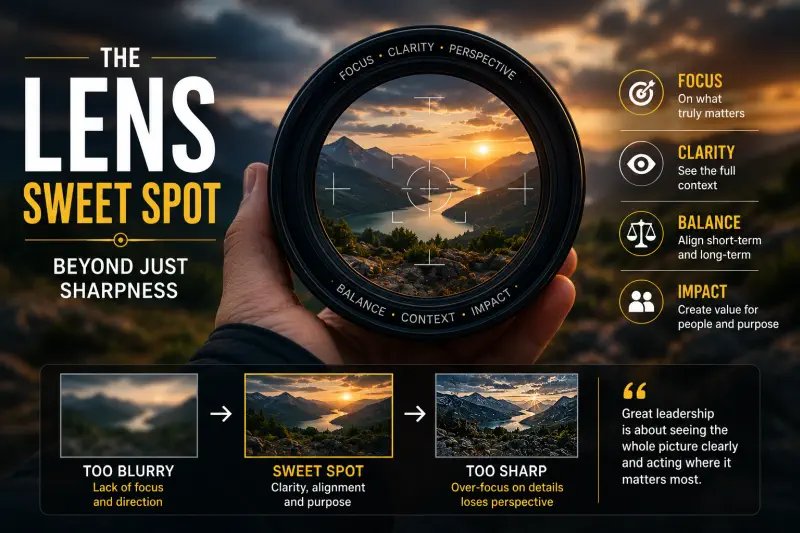
Most photographers hear about the “sweet spot” as a technical rule of thumb, usually something like “shoot at f/8, it’s sharper.” But that idea barely scratches the surface. The real value of understanding your lens’s sweet spot isn’t about chasing perfection; it’s about learning how your lens behaves, and knowing when to use that behaviour, when to push it, and when to ignore it entirely.
What’s Really Happening Inside the Lens
Every lens is constantly juggling two opposing forces. At wide apertures, light enters through the outer edges of the glass, where optical imperfections are strongest. This is why wide open shots often show reduced sharpness, lower contrast, and sometimes colour fringing. Stopping down helps because you’re effectively using the cleaner, more precise centre of the lens.
But go too far in the opposite direction and you hit diffraction. At very small apertures like f/16 or f/22, light waves bend and scatter as they squeeze through the narrow opening. This softens the entire image, even on the best lenses. The sweet spot sits between these two extremes, the point where aberrations have calmed down but diffraction hasn’t yet taken over.
Sharpness Isn’t Just One Thing
Most discussions stop at “sharp vs soft,” but sharpness is actually a combination of resolution and micro contrast. Resolution is your ability to capture fine detail; micro contrast is how clearly edges and textures separate from each other. When a lens hits its sweet spot, both of these qualities improve together, which is why images suddenly feel crisp, clean, and full of depth.
It’s also worth remembering that sharpness isn’t uniform across the frame. Wide apertures often give you a sharp centre with softer edges, while mid range apertures balance the frame more evenly. Very small apertures soften everything equally. This is why landscapes benefit so much from sweet spot shooting, while portraits often don’t.
How the Sweet Spot Plays Out in Real Life
In landscape photography, where the goal is maximum detail from corner to corner, shooting around f/8 to f/11 usually gives the best balance of clarity and depth of field. Architectural work is similar, edge to edge sharpness matters, and even slight softness in the corners becomes noticeable.
Portraits, however, flip the script. Here, the goal is separation, mood, and character. Shooting wide open is often the better choice, even if it means sacrificing technical sharpness. The softness becomes part of the aesthetic. And in low light or street situations, the sweet spot becomes irrelevant, exposure and capturing the moment matter far more than optical perfection.
The Trap of Always Shooting at f/8
One of the biggest mistakes photographers make is treating the sweet spot as a rule instead of a tool. If you always shoot at f/8, you lose creative control over depth of field, and your images can start to feel clinical or predictable. Photography is about intention, not default settings.
A better question than “What’s the sharpest aperture?” is “What does this image need?” Do you want depth or separation? Clarity or softness? Precision or emotion? The sweet spot is just one option in your creative toolkit.
Testing Your Lens the Right Way
If you want to understand your lens’s behaviour, don’t just photograph a blank wall. Real world textures, brick, foliage, fabric, high contrast edges, reveal far more about how your lens handles detail, contrast, and corner performance. This kind of testing shows you how the lens behaves in the situations you actually shoot.
Final Thought
The sweet spot isn’t about making every image sharp. It’s about knowing when sharpness matters, when it doesn’t, and when breaking the rules leads to a better photograph. Great photography isn’t built on technical perfection, it’s built on intentional imperfection, and on understanding your tools well enough to choose the right kind of “perfect” for each moment.

Technical Mastery, Optics, Digital Workflow, The Science Behind The Image
Leave a Comment