The Leadership Chain | Peter Farrar Books How Leadership Scales Through an Organisation
Why Leadership Is a System Rather Than a Role
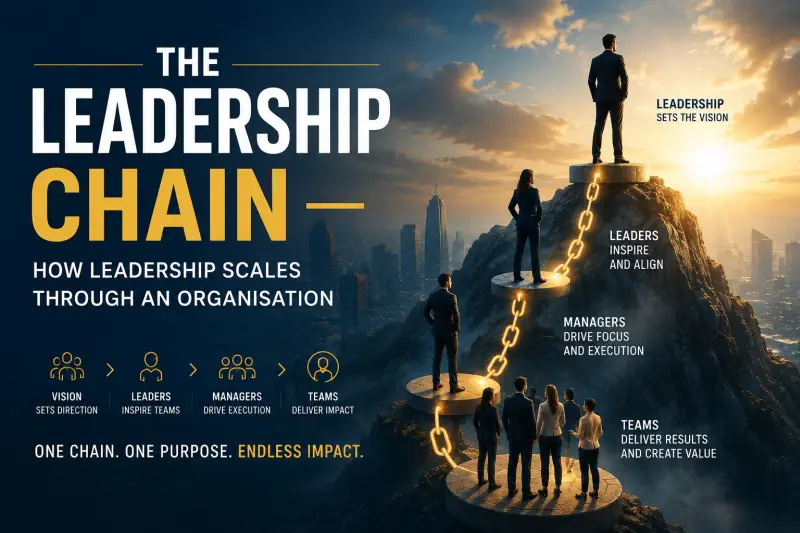
Leadership is often viewed as the performance of a single individual, but real organisational strength comes from something far more interconnected. Successful organisations do not rely on one exceptional leader. They succeed because leadership is connected, aligned, and reinforced at every level. This interconnected structure is what forms the leadership chain, a system where each layer influences the next and the entire organisation rises or falls based on the strength of these connections.
What the Leadership Chain Represents
The leadership chain describes the flow of leadership through every level of an organisation. Each level depends on the strength of the one before it, and any weakness affects everything above and below. It mirrors the idea of a leadership pipeline, where leaders grow progressively through stages of responsibility. Leadership is not isolated. It is built over time, developed in layers, and sustained through continuous progression. A strong organisation cultivates leaders at every level and ensures that transitions between roles are clear and supported.
How Leadership Progresses Through Levels
The leadership chain can be understood as a series of developmental transitions. It begins with managing oneself, where personal responsibility and individual performance form the foundation. It then moves into managing others, where the focus shifts from doing the work to enabling others to succeed. The next stage involves managing managers, which requires the ability to lead through others and influence outcomes indirectly. Beyond this lies functional or business leadership, where strategy, alignment, and cross team coordination become essential. At the highest level is enterprise leadership, where the focus expands to organisation wide vision and long term direction. Each stage demands new skills, new priorities, and a new mindset.
Why It Is Described as a Chain
It is called a chain because each level depends on the one below it, and each leader shapes the next generation. When one link weakens, performance suffers, culture erodes, and execution becomes inconsistent. A strong chain creates stability, clarity, and alignment. A weak chain creates confusion, frustration, and organisational drift.
Where the Leadership Chain Breaks
Many organisations struggle because they promote people without developing them. High performing individuals are often moved into leadership roles without the skills required to succeed. Others fail because new leaders cling to old behaviours, continuing to do the work themselves instead of evolving into their new responsibilities. Some organisations lack a clear leadership pathway, leaving people unsure of what skills they need, how to grow, or what leadership progression looks like. When development is absent, leadership becomes accidental rather than intentional.
Why the Leadership Chain Matters in Modern Organisations
Today’s organisations face constant change, larger and more distributed teams, and increasing complexity. Leadership becomes harder to scale and more dependent on consistency. A strong leadership chain ensures continuity when leaders move on, consistency in decision making across levels, and a culture that remains stable and reinforced at every layer. It creates an organisation that can adapt, grow, and maintain direction even during disruption.
The Hidden Insight, Leadership Multiplies
One strong leader can influence a team, but a strong leadership chain multiplies that influence across the entire organisation. Instead of one leader guiding many employees, you create leaders who develop more leaders. This creates exponential growth, deeper capability, and a culture that sustains itself.
Leadership Chain Compared to Individual Leaders
Individual leadership focuses on one person and creates short term impact that depends heavily on personality. The leadership chain focuses on the system itself, creating long term scalability that is resilient rather than fragile. It shifts the emphasis from individual brilliance to collective strength.
How Organisations Strengthen the Leadership Chain
ong organisations define leadership levels clearly, prepare people before they are promoted, build structured leadership pipelines, and encourage mentoring and coaching. They understand that leadership transitions are the most challenging moments. The difficulty is not becoming a leader but becoming the next kind of leader. Each transition requires letting go of old habits and adopting new ones, such as moving from doing the work to managing it, from managing tasks to managing people, and from managing people to shaping strategy. Most leadership failures occur during these transitions.
Final Philosophy
dership is not about one exceptional person at the top. It is about a chain of people who develop one another, support one another, and strengthen one another. Organisations do not rise to the level of their best leader. They rise, or fall, to the strength of their entire leadership chain.
How Great Managers Transform Toxic Workplaces into High-Performing Teams
Leave a Comment